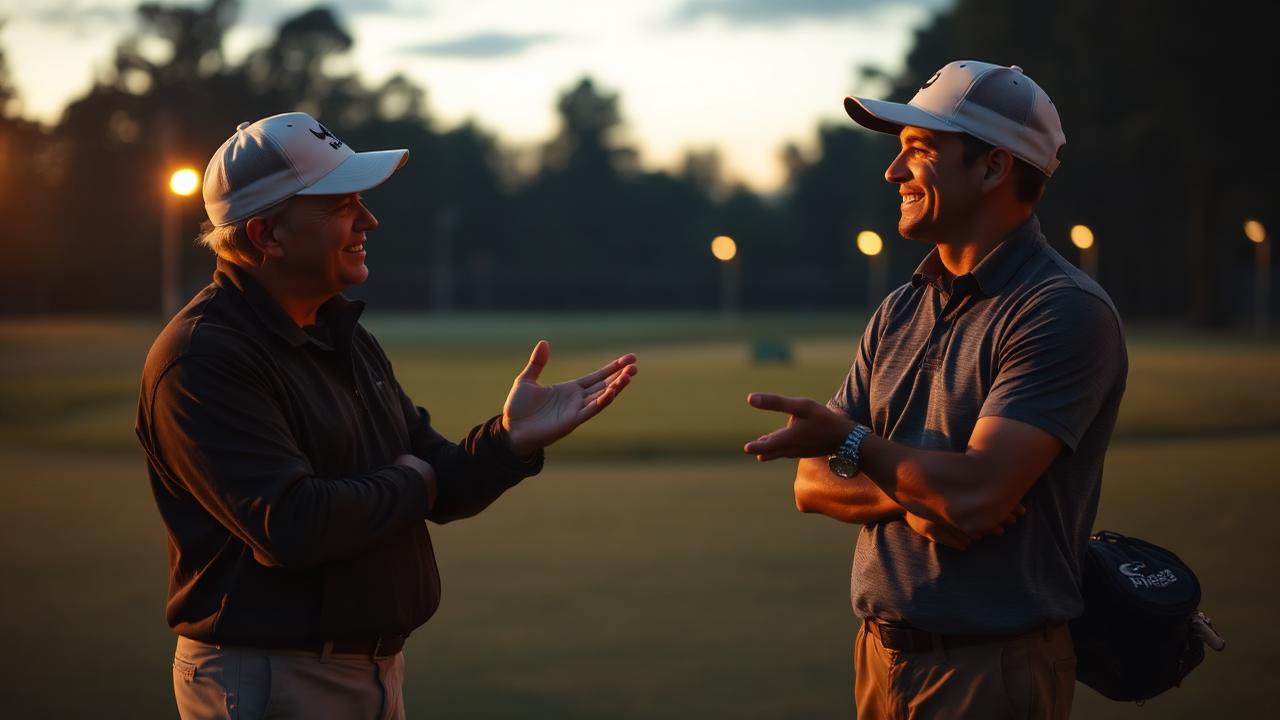
When a Pro Gamer Meets a Golf Pro
Daltoosh isn't your average golf student. Known to millions as one of the most popular gaming streamers in the world, he brought the same competitive fire to the lesson tee that made him famous online. But wedge play? That was a different battlefield entirely.
When Daltoosh reached out, his request was simple: "I can hit my driver. I can putt. But I'm losing all my strokes from 100 yards and in." If you're reading this and nodding, you're not alone — that's where most amateur golfers hemorrhage shots.
The Assessment
Before we picked up a club, I walked through his typical approach to wedge shots. The problems were immediately clear. His distance control was inconsistent — the same swing produced wildly different carry numbers. He had no system for partial shots, just a full swing and a chip with nothing reliable in between. And he was decelerating through impact — the fear of going long caused him to slow down, which paradoxically made contact worse.
This is the pattern I see in about 80% of amateur golfers. It's not that they can't hit wedges. It's that they don't have a system.
The BGP Wedge System
I teach wedge play using a clock-based system that gives every golfer three reliable distances with each wedge.
At the 7 o'clock position, your hands swing back to hip height. This is your shortest distance. At 9 o'clock, your hands reach shoulder height — that's your medium distance. And at 10:30, your hands go to full backswing for the longest partial swing. For each position, the tempo stays the same, the follow-through matches the backswing length, and the key metric is landing distance, not total distance.
With three positions and four wedges — PW, 50°, 54°, and 58° — Daltoosh suddenly had 12 reliable distances instead of zero. I had him hit five shots at each position and record the average carry. His PW went 85, 110, and 130 yards at the three positions. His 50° went 70, 95, and 115. His 54° went 55, 75, and 95. And his 58° went 40, 60, and 80.
With that chart memorized, he could walk up to any yardage between 40 and 130 yards and know exactly which club and position to use. No guessing. No feel-based improvisation. Just a system.
The Technique Adjustments
Beyond the system, I made three mechanical changes. First, ball position. He was playing wedges too far forward in his stance, which encouraged an ascending blow and inconsistent contact. Moving the ball to center-to-slightly-back immediately improved his strike.
Second, weight distribution. For all partial wedge shots, I want 60% of the weight on the lead foot at address — and it stays there throughout the swing. No weight shift back. This pre-sets the low point ahead of the ball.
Third, and the biggest change: shaft lean at impact. Daltoosh had been flipping through impact — his hands stopping while the club head passed them. That creates inconsistent loft and zero compression. The fix is to feel like you're dragging the handle through impact. The divot should start after the ball position, not before it.
The Transformation
Over the course of 27 minutes, the change was visible on camera. He went from spraying wedges with 15-yard distance variance to stacking shots within 5 yards of his target consistently.
The moment it clicked — around the 18-minute mark — you can see it in his reaction. "Wait... that's the same swing I just made, and it went the exact same distance." That's the system working. Same input, same output. Every time.
Why This Lesson Went Viral
With 24K+ views, this video resonated because it showed something golfers rarely see: a complete transformation in real time with a personality people already knew and trusted. But the real lesson isn't about Daltoosh. It's about the system. The BGP Wedge System works for every golfer — from a 30-handicap to a scratch player. The distances in the chart change, but the framework is identical.
If you take one thing from this, build your own distance chart. Take your wedges to the range, hit five shots at each clock position, and record the averages. Start with the 7 o'clock position — it's the shortest, easiest, and builds the most confidence. Commit to the system for 30 days before mixing in feel shots. You'll be shocked at how many strokes you save from 100 yards and in.
Watch the full 27-minute lesson above and start building your wedge chart today.